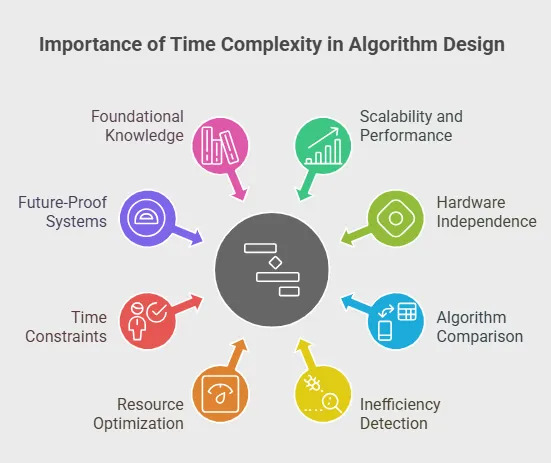
Why analyze algorithms? Writing functional code is only half the battle. In professional ecosystems, software solutions must be mathematically vetted to guarantee performance under load.
Algorithm analysis provides a hardware-independent blueprint to evaluate resource execution behaviors, helping engineers eliminate optimization bottlenecks prior to deployment matrices.
Efficiency
Saves execution time, memory footprints, and raw device energy consumption profile arrays.
Scalability / Throughput
Sustains processing criteria smoothly when tracking over massively scaled external datasets.
Predictability / Knowability
Ensures machine behaviors remain mathematically verifiable, analyzable, and completely consistent.
Optimization
Maximizes target system asset allocations and enhances physical architecture limits.
Foundational Objectives
Theoretical Foundation
Serves as the absolute structural core of all software development frameworks and modern computer science theories.
System Portability
Ensures execution parameters remain consistent and functional when ported across distinct operating networks and platforms.
Comparative Evaluation
Provides objective mathematical criteria to weigh alternative algorithms and isolate optimal code routes.
Continuous Improvement
Establishes mathematical baselines needed to iterate, optimize, and engineer superior versions of algorithms.
Research & Architectural Innovation
Fuels ongoing innovation, enabling new cryptographic safety layers and secure architectural paradigm breakthroughs.